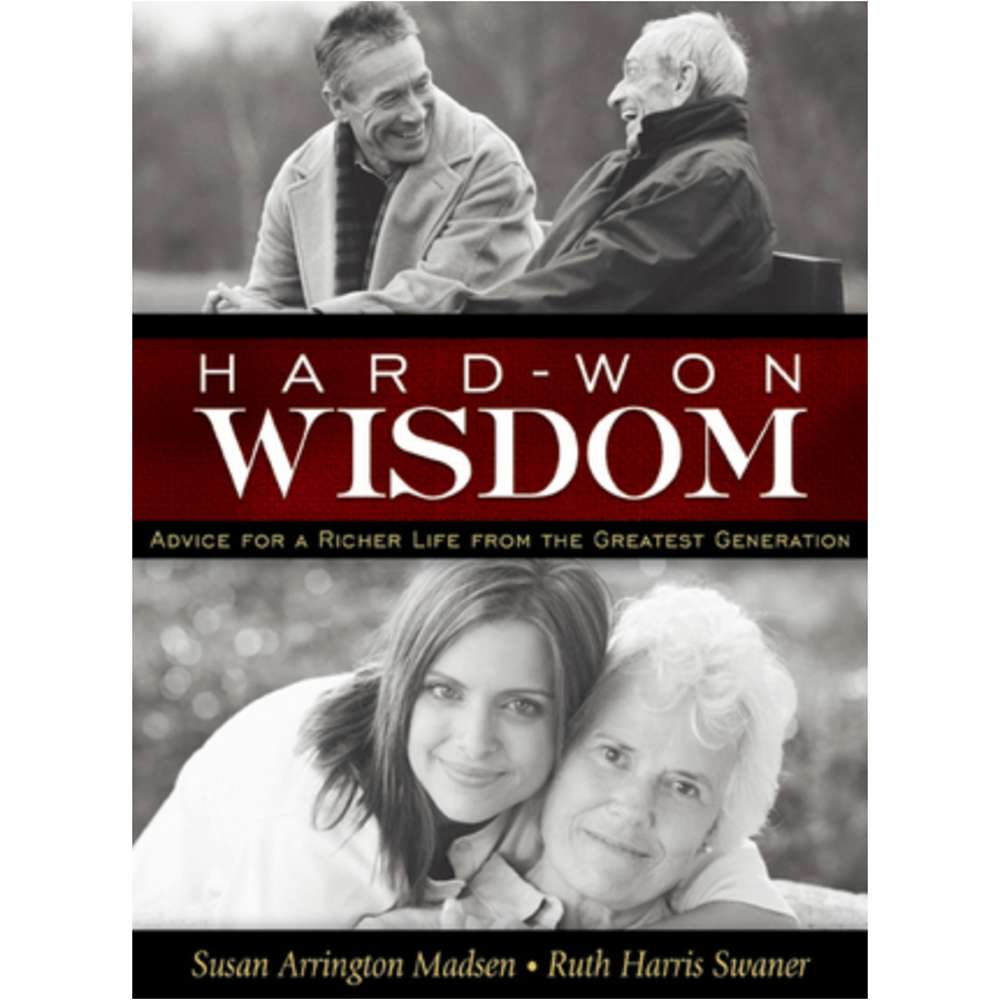
Hard-Won Wisdom: Advice for a Richer Life from the Greatest Generation (Bookshelf eBook)
by Susan Arrington Madsen, Ruth Harris Swaner
eBooks: Looking for more eBooks?
Click here to shop our huge selection of eBooks.
Product Description
Theirs are the unforgettable stories gleaned from seventy, eighty, ninety, and even one hundred years of living. They come from the retired schoolteacher across the street, the World War II veteran who lives around the corner, the elderly couple who walk past your home every evening. Like magnificent trees, these remarkable souls have weathered and withstood decades of blustery storms, hard knocks, and pesky disease to bless our lives with their wisdom. Each has gained a sense of peace, gratitude, and acceptance of the things they have learned in this life — and now pass to the next generation. This is the story of private battles, quiet victories, and deeply felt emotions to be shared and enjoyed by readers of all ages.
About the Authors
Susan Arrinton Madsen is author of several books. She and her husband, Dean, have four daughters and live in Hyde Park, Utah.
Ruth Harris Swaner was born and raised in Smithfield, Utah. Her work has been published in numerous magazines and newspapers, and she has served as president of the League of Utah Writers. She has won more than two dozen awards for her writing.
Children Cherish Private Time with Parents
My father, Bryant Hinckley, was the manager of the Deseret Gymnasium. How I loved that gymnasium! You could dance and swim. It had everything a little kid could want to do. My father would take me there in the summer to participate in all the activities. Then, he and I would walk from the gym to our home on 7th South between 8th and 9th East. It was a pretty good walk. I loved that walk with him. He would tell me where everyone lived along the way. He knew everyone, being the president of the stake, and he would tell me all about them. I would dance along, and he would hold my hand all the way home. That is a very special memory of my father—just him and me walking hand-in-hand.
Years later I would look back on those summer evening walks and realize how important it is for children to have private, individual time with their parents.
Ramona experienced a great loss at the age of fourteen when her mother, Ada Bitner Hinckley, died of cancer. Now in her nineties, Ramona still gets teary, remembering how difficult it was to lose her mother at such a young age. Thus, it meant even more to her to have a close, meaningful relationship with her father.
DISCIPLINE DOESN’T HAVE TO BE PHYSICAL
As a young man, I once went with a group of guys to a movie in our town, then to drinking beer, and then to a café to sober up before going home. While in the café I got a tap on my shoulder. I looked up, and it was my mother. She said, “Clark, I hope you are proud of yourself tonight,” and then she left. That was the worst licking I ever received. It was worse than any physical punishment. I never did those things again.
Clark grew to appreciate how his mother handled certain situations. He also admired his maternal grandmother. When his parents divorced, Clark and his brother and his mother went to live with his grandmother. “She had nothing,” he remembers. “She was poor and growing older, and yet she welcomed us into her home. I learned that whatever I have, even if it is very little, I can still share it to help someone else.”
CLOTHES DON’T HAVE TO BE EXPENSIVE, JUST “IN GOOD TASTE”
My mother was a very refined person. She believed in courtesy, manners, and behaving properly. If I ever did anything she thought was improper, she would always say, “It isn’t in very good taste.” So I learned that lesson early on. I think about that all the time because today the way people act and dress—the words “good taste” have just gone out of our vocabulary.
My folks always shopped at ZCMI. When we shopped, Mother required me to wear my Sunday-best clothes. She would also wear her best dress, along with a hat and white gloves. On the way home I was already loosening my tie and getting ready to get into my play clothes.
Today, when I go to a nice place to have dinner and see someone coming in wearing Levi’s and tennis shoes, I just kind of shake my head and say, “Mother wouldn’t approve of that.”
When Richard’s mother raised him to have respect for how he dressed in public, she unwittingly prepared him for one aspect of his life’s work. For more than twenty years, Richard would spend most of his day wearing black judicial robes as he served as a highly respected justice of the Utah Supreme Court. Previous to that appointment, Richard served for twelve years in the Utah House of Representatives, where he became Speaker of the House. He then spent six years in the Utah Senate.
TREAT EVERYONE THE WAY YOU WANT TO BE TREATED
Ibecame a lawyer and practiced law with my father. One of my first cases was an automobile accident. The people were seriously injured, and the other driver was clearly at fault. Our client wanted to recover his money and then some.
My father told me and the client in the office, “We are not the usual kind of lawyers. We will recover your medical expenses and our attorney fees, but we’re not going to ask anything for pain or suffering and extra damages.” He continued, “We know this man is at fault, but he’s a person like you and me. He doesn’t have the money.”
The client spoke up. “They’re insured, aren’t they?”
Dad said, “Well, even if they are insured, someone will pay the bill because someone else is negligent. And they really shouldn’t have to, should they?”
And I asked, “Dad, how are you going to make money practicing law this way?” But the case was settled, and our clients got their medical expenses and attorney fees paid.
Afterwards, Dad said to me, “Remember, son—before you’re a lawyer, you’re a Christian. You treat everybody the way you would like to be treated.” We were not rich lawyers, but we always got by.
Ted has spent a lot of time in a suit and tie. His wife claims she has ironed a white shirt for him at least once a day for all their married life. Ted had a successful law practice for thirty-six years and was a circuit court judge for eleven years. He served a term as mayor of Logan, Utah, was chairman of the board of trustees of the Logan Regional Hospital, and was director of the First National Bank in Logan.
SOMETIMES PARENTS HAVE TO PUT ON A BRAVE FRONT
When my mother was fourteen years old, she stood beside her mother, my grandmother, watching an electrical storm. My grandmother was a doctor. She wore a watch over her heart so she could tell what time a baby was born or a person died, just by checking her watch. Tradition says that watch attracted a lightning bolt. It hit my grandmother and went over and hit my mother. Both of them were very sick. They didn’t think my grandmother would live. But they both lived.
My mother, after that, was very afraid of lightning, but she never told us children. When there was a lightning storm, she would squeeze all of us into a closet. We would sit on raincoats, and she would tell us stories until the lightning was over. We never knew she, too, was afraid. It was wonderful to be there with her. She never divulged her great fear until we were much older.
Barbara has seven children, thirty-nine grandchildren, and ninety-one great-grandchildren. She enjoys working at the temple once a week. Her hobbies include collecting pictures for her family history book to eventually be given to her children and grandchildren. She belongs to several church study groups and two social groups. Barbara served as general president of the Relief Society from 1974 to 1984.
WE CAN’T REPLACE OUR LOVED ONES
When I was in the seventh grade, we were to play a basketball game in Monroe, Utah, which is about thirty-five miles away from where I lived. I volunteered to let our principal, Mr. Overson, drive us in our family car. On our way home, we were singing songs, celebrating our victory at the game, and then suddenly boom! We ran smack into a horse. We stopped, of course, and found out the horse wasn’t injured. The car was slightly damaged but not much. I was nervous the rest of the way home, knowing I had to tell my dad.
When I got home, I thought he would be really mad. When I told my dad, he just looked at me for a long time. Then he said, “Was anyone hurt?”
I said, “No.”
He was relieved and then said, “We can always replace cars, but we can’t replace our loved ones.” Then he put his arms around me, and I thought, I have the best dad in the whole wide world.
Mella’s father, Conrad Erastus Peterson, mayor of Salinas, Utah, was well-known as “a kind-hearted and charitable man.” Mella remembers the love and warmth she felt that night as her dad held her in his arms. It remained a sweet memory with her for the rest of her life.
MOTHER TAUGHT ME THE FINE ART OF MAKING FRIENDS
Mother never let anyone get by her without being a friend. There was a man in our ward, the ward clerk, who was the worst sourpuss you could ever imagine. He was always frowning. My mother said, “I’m not going to let him get away with that.” So she went out of her way to be nice to him. She would take him little favors and ask his advice. It wasn’t long before this man just lighted up when she came around. That was one of the best lessons she ever taught me. Now, when someone ignores or rebuffs me, I think of what Mother did, and I say, “You’re not going to get away with that. You’re going to become my best friend.”
Part of having the energy to reach out to others has to do with feeling good and living a healthy lifestyle, Beth says. She attributes her good health to exercise, eating right, and yoga. Beth was the first female cheerleader at Brigham Young University in 1939. Now in her late eighties, she believes you need to “think healthy” and then live to be that way. Beth has seven children, thirteen grandchildren, and seven great-grandchildren. She serves as an ordinance worker in the Logan Utah Temple for Spanish speakers one day a week.
WORK HARD AND BE FRUGAL
Igrew up in the years of the Great Depression. There was a 30 percent unemployment rate then, and jobs were hard to come by. We had very little money and had to be careful in our expenditures.
My mother, God bless her, worked side by side with Father in providing for our needs and paying our bills. I never heard a murmur from her as she did her part in making our home a place where the spirit of the Lord could be felt. Even though we produced carloads of the finest apples, she always felt she had to use those we couldn’t sell—the culls—to cook with at home. I haven’t forgotten the time when she asked me to find her some cooking apples. I took her some real nice ones. She scolded me and sent me back for some “rejects.”
These lessons in frugality contributed much to my success in life. Using an old wood and coal stove, Mother canned and bottled fruit and vegetables all summer long so that our food storage would be well stocked. She made the best bread, pies, and pastries of all kinds. She washed, sewed, ironed, and mended our clothes. She was the most unselfish person I have ever known.
There was, however, one item that Mother prepared that appeared on the dinner table too often, I thought, and that was small, creamed onions. I hated them, but I was encouraged to eat them. I think my parents operated on the assumption that if I ate them I would like them, but it didn’t work that way. One day I was served headcheese made from parts of a hog’s head. Boy, all of a sudden creamed onions became a delicacy!
Jesse rarely wore anything other than a pair of overalls, unless he was going to church or the temple. When he died, he left three well-worn pairs to be inherited by three lucky descendants.He loved genealogy and treasured a trip to Switzerland to see where his mother was born. He hated going to the doctor and had a famous bit of health advice for his family: “The whiter the bread, the sooner you’re dead.” He read the scriptures every day and planted a huge garden—including an acre of peas! He and his wife, Idona, were married sixty-seven years and died exactly one month apart.
Learn Wisdom in Your Youth
by Cynthia - reviewed on March 27, 2007
This book has 'hard-won' wisdom from those in society that might be overlooked. I enjoyed the short stories and then summary of each elderly author on the right-hand of the page often with pictures! We can never learn or appreciate enough those who have lived life and have much to share!
This is an amazing book!
by Kyle - reviewed on September 13, 2008
I would recommend this book for a gift for anybody. It is also great as a present. It has many good stories and pieces of advice for any situation!

Points
Add to My Wish List