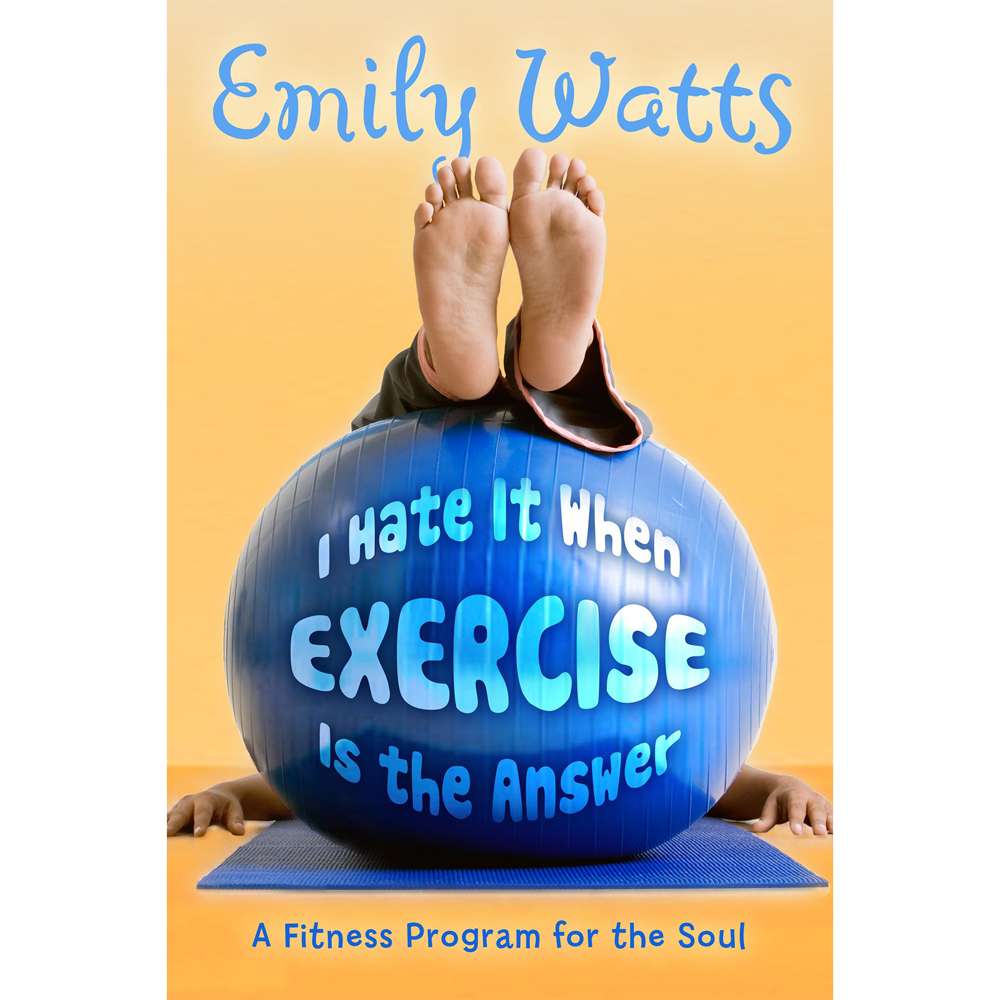
I Hate It When Exercise Is the Answer: A Fitness Program for the Soul (Paperback)
by Emily Watts
$14.95
List Price
✔ IN STOCK: Ships in 2 to 3 business days
Domestic and International Shipping Options
Other Formats Available
Product Description
Pick up any woman's magazine. Read any pamphlet in your doctor's office. Like it or not, you'll find that exercise seems to be the prescription for just about every ill, from diabetes to heart disease to depression to (ironically) fatigue.
Luckily, exercise bikes, dumbbells, and spandex suits are not needed in these 31 exercises to help keep our spirits in shape. I Hate It When Exercise Is the Answer is filled with funny, easy-to-relate-to stories that also come with lessons, such as: how a tax return can teach us perspective, how a big cookie teaches about assumptions, and what an engine-free car has to do with adjusting our expectations. In her lighthearted and conversational style, author Emily Watts offers ideas to improve our spiritual and emotional fitness. In just one short month, you could be a better, happier, more spiritual you!
This is one fitness tool that won't end up gathering dust in the corner of your room.
Product Details
- Pages: 192
- Published: 2009
- Size: 5" x 7"
About the Author
Learn more about Emily at EmilyWatts.com
Emily Watts is a lover of words. A graduate of the University of Utah, she has been an editor for Deseret Book Company for more than thirty years, much of that time working from home part-time so she could devote most of her attention to her husband and their five children. She is now a senior editor at Deseret Book. She loves serving in the Church and has spent most of her adult life teaching in the various auxiliaries, but her favorite calling is as a grandmother. Emily and her husband, Larry, live with their family in Taylorsville, Utah. She is the author of four inspirational books: Being the Mom; Take Two Chocolates and Call Me in the Morning; Confessions of an Unbalanced Woman; and I Hate It When Exercise Is the Answer.
Fat Boys: An Exercise in Understanding Men
My children are now all of the age where male-female relationships play a prominent role, and watching them has reminded me how mystified I was as a young adult woman at the seeming unfeelingness of the young men in my world. This extended into my married life, in which I could scarcely believe that my husband could be so clueless as to not recognize how it affected me when, for example, he didn’t even care enough about our family to take out the garbage.
Now, many years later, I’ve seen the research studies that suggest men’s brains are actually structured differently from women’s brains, and that the connection between brain hemispheres that allows women to multitask and to process complex relationship issues is typically not as developed in men. Their brains are programmed to forge ahead singlemindedly and conquer problems—a significant and perhaps undervalued skill in today’s culture.
A chance scene in volume 5 of the Harry Potter series illustrates these brain differences beautifully. In volume 4, Harry had a crush on a girl named Cho but could never get anywhere because she had a boyfriend. That boyfriend, Cedric, got killed by the evil wizard Voldemort in front of Harry’s eyes at the end of volume 4. In volume 5, Cho and Harry end up in a situation where they kiss. It’s the culmination of Harry’s dream, but Cho is crying the whole time. Harry expresses his bewilderment over this to his friends Ron and Hermione, and Ron is as confused as he is. Not so with Hermione.
“Hermione looked at the pair of them with an almost pitying expression on her face.
“ ‘Don’t you understand how Cho’s feeling at the moment?’ she asked.
“ ‘No,’ said Harry and Ron together.
“Hermione sighed and laid down her quill.
“ ‘Well, obviously, she’s feeling very sad, because of Cedric dying. Then I expect she’s feeling confused because she liked Cedric and now she likes Harry, and she can’t work out who she likes best. Then she’ll be feeling guilty, thinking it’s an insult to Cedric’s memory to be kissing Harry at all, and she’ll be worrying about what everyone else might say about her if she starts going out with Harry. And she probably can’t work out what her feelings toward Harry are anyway, because he was the one who was with Cedric when Cedric died, so that’s all very mixed up and painful. Oh, and she’s afraid she’s going to be thrown off the Ravenclaw Quidditch team because she’s been flying so badly.’
“A slightly stunned silence greeted the end of this speech, then Ron said, ‘One person can’t feel all that at once, they’d explode’ ” (J. K. Rowling, Harry Potter and the Order of the Phoenix [New York: Scholastic, 2003], 459).
I laughed and laughed when I read that because it was such a brilliant example of the differences in how men and women see the world. And understanding that there are differences, and that those differences are fairly common, makes it easier not to be offended when men don’t always seem to “get it.”
To give the men in my life credit, I think they try. Take Mother’s Day in my ward, for example. To start with, the men take over the Church jobs of all the women in the ward so that they can relax and attend Sunday School and Relief Society and be together. I think that’s a great start, don’t you?
Then, I know (because my husband has spent years in various bishoprics) that they agonize over what gift to present to the mothers. Plants are a frequent choice, but we have many apartment dwellers in our ward who have no place to plant them. Cut flowers seem to be out of the question—too many men perceive them as a waste of money although women in surveys say they would rather receive fresh flowers than a plant. One year we got a nice booklet. Another year I was in Seattle on Mother’s Day, and the bishopric in that ward presented the women with large-size Cadbury chocolate bars, which I applaud most heartily except I know our bishopric shies away from those, too, as unsuitable for diabetics.
Next is the awkwardness of how to present the gift. It has long since been a practice to include all the women, not just those who have borne children. The instinct is right, but it’s still tough for the single women in our ward to make themselves stand up. And the day is tough for lots of mothers too, who don’t feel like they measure up to the “ideal mother” who is likely to be extolled in the sacrament meeting talks, so the bishopric sweats over whom to invite to give those talks as well.
They just don’t want to offend anyone. That seems to be their primary goal on Mother’s Day: It’s not to honor the moms. It’s not to honor motherhood or even womanhood in general. It’s just to not make anyone upset. This is not their fault. This is our fault (the women’s, I mean) for making it all complicated emotionally and for reading the wrong message into everything they’re trying to present.
Contrast this with Father’s Day. For many years, we didn’t even observe Father’s Day in our ward, and no one ever complained. (That should be a clue right there as to the differences between men and women.) Now we have a tradition that during the last ten minutes of priesthood meeting, they gather all the classes from deacons to high priests together in the multi-purpose room and present them with “Fat Boy” ice-cream sandwiches. Everyone is happy. No one tries to probe for subliminal meaning in the choice of “Fat Boys.” They eat their ice cream and yuk it up and go home happy.
What would happen in your ward if they tried to give “Fat Boys” to the women on Mother’s Day? Almost too horrible to contemplate, isn’t it?
So, which is better, the men’s way or the women’s way? Neither, of course. They’re just different. Instead of being frustrated by those differences, we can actually come to value them. I know I have grown to appreciate my husband’s steady clarity when I’ve gotten emotionally overwrought about a situation. And he seems to appreciate my ability to “read” the children and understand what’s going on in their brains that is affecting their actions. We need both skills in our family, and in our ward, and in our world.
Exercise #7: Understanding Men
Next time you’re frustrated because you don’t seem to be getting a response from the man in your life, remind yourself that he’s not being deliberately obtuse. It’s just the way he’s wired. Communicate your needs clearly and directly, and don’t forget to express gratitude when they are met.
Refreshingly Funny
by Customer - reviewed on July 14, 2009
I love Emily Watts' way with words and humorous stories to teach and uplift. I'm really looking forward to reading her new book!
Great advice in a fun lighthearted book!
by Joyce - reviewed on August 04, 2009
This book is full of great advice, and achievable goals that will help strenghten us spiritually. In a fun humorous way Emily looks at life the way most of us do, and she has a great ability to put it into words. I look forward to more from her.

Points
Add to My Wish List