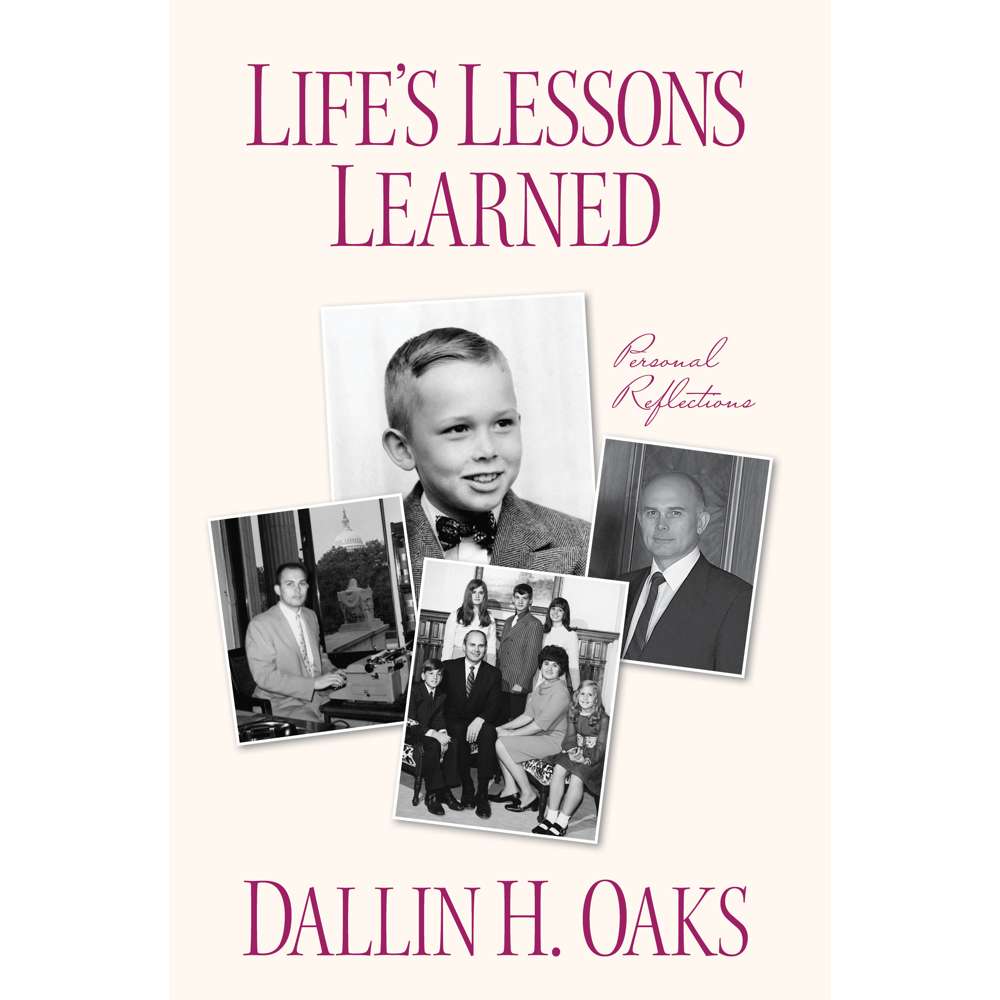
Life's Lessons Learned (Hardcover)
by Dallin H. Oaks
✔ IN STOCK: Ships in 2 to 3 business days
Domestic and International Shipping Options
Other Formats Available
Product Description
“I have learned things that have shaped my life and teachings, including some things of the heart not previously shared,” writes Elder Dallin H. Oaks in the introduction to this unique book. “This is an autobiography of learning and application rather than a compendium of doctrine.”
Masterfully blending personal experiences with the doctrines of the gospel, Elder Oaks invites us to join him on a journey through some of the turning points in his life and the lessons he has learned through a lifetime of devotion to the Savior.
The short but potent chapters offer perceptive observations into such diverse topics as the purpose of adversity, the importance of respecting those with whom we disagree personally or politically, the merits and limitations of law, the blessings of tithing, the seeming conflict between science and religion, the Lord's use of imperfect people to further His work, and the power of the Atonement to recover those who have fallen behind.
Elder Oaks also relates the very personal lessons he learned from the death of his wife, June, and from his subsequent marriage to Kristen McMain.
Woven throughout the book is Elder Oak's powerful testimony of the Savior and His mission. Life's Lessons Learned is a rare glimpse into the experiences of the heart that have shaped the life of an Apostle of God.
- Contents
- Introduction
- "Not My Will, but Thine, Be Done"
- Recovering
- Temple Teachings
- The Influence of Family Histories
- Honor the Sabbath Day
- Humility
- The Challenge of Indifference
- Separating Respect, Affection, and Policy
- The Law Is a Blunt Instrument
- Turning Points in Life
- Worldly Wisdom Yields to Revelation
- Preparing for Things to Come
- Science and Religion
- What Do You Want to Be Remembered For?
- Assigning Reasons to Revelation
- Adversity
- Feelings
- Goal Setting
- Personal Revelation
- Leadership
- Learned from Legal Training
- Transition to the Apostleship
- Unselfish Service
- The Meaning of "Real Intent"
- Refusing Requests
- Recognizing Revelation
- Labeling and Timing
- Tithing Blessings
- Sins and Mistakes
- Looking info the Future
- Principles versus Preferences
- Caution in Sharing Spiritual Experiences
- Death of a Spouse
- Second Marriage
- Shaking Hands at Stake Conferences
- Good Fruits from Unlikely Sources
- Testimony of Jesus Christ Index
Acknowledgments
PART 1. TO 1971
PART II: BRIGHAM YOUNG UNIVERSITY AND THE UTAH SUPREME COURT, 1971 TO 1984
PART III: GENERAL AUTHORITY, 1984 TO PRESENT
Product Details
- Size: 6" x 9"
- Pages: 160
- Published: September 2011
About the Author
Elder Dallin H. Oaks was sustained as a member of the Quorum of the Twelve in April 1984. He graduated from Brigham Young University and holds a juris doctor degree from the University of Chicago. Prior to his call as an apostle, he served as a law clerk to Chief Justice Earl Warren of the United States Supreme Court and as a professor of law at the University of Chicago, as president of BYU and as a Utah Supreme Court justice. He is the author of several books, including Pure in Heart, The Lord’s Way, and His Holy Name.
Leadership
I have been privileged to exercise leadership responsibilities in family and Church and in business, education, military, and charitable organizations. By watching leaders, by experiencing their leadership, and by exercising leadership responsibilities myself, I have learned some basic principles that have value in each of these areas.
My interest in leadership began with my teenage reading of the biographies of World War II military leaders. In college and law school my interest expanded to the biographies of public leaders. Throughout my life I have observed effective (and less effective) leadership by various parents and grandparents. As a university president I enjoyed reading the counsel and experiences of educational leaders. Best of all, for more than forty years I have been a close observer of the great men and women who are leaders in The Church of Jesus Christ of Latter-day Saints. I have sought to learn how to get men and women to do an assigned job, to do it well, and to enjoy the process.
Following are seven important leadership principles I have learned from my life’s experiences:
1. Love is the first principle. Its effect magnifies the effects of every other principle. Leaders who are loved and who love those they lead enhance the impact of their leadership and the duration of their influence.
2. Good leaders are not overly concerned with popularity, knowing that popularity follows good leadership—it does not produce it.
3. Good leaders make decisions that can be relied upon because they stick with them.
4. Good leaders are positive. Optimism is infectious. People have confidence in and work best for leaders who view adversity as a challenging opportunity and who are positively and thoughtfully confident in the assigned task and the desired outcome.
5. Good leaders are clear in defining what is expected, able to express it in simple terms, and effective in communicating with those they lead. These three qualities are so interrelated that I cannot give examples that do not, in some measure, include all of them.
President Gordon B. Hinckley was a genius at stating a principle or giving a challenge in such clear, simple terms that it drew all of us into increased understanding and more effective efforts. A few years ago he told the Church that we should raise the bar for missionary service.1 He gave no complicated explanation. He just used that vivid metaphor to give a clear, simple challenge that expressed an ideal most of us understood and shared. The impact of that challenge has been felt by Latter-day Saint teenagers, parents, teachers, and leaders everywhere. That is leadership through simplicity, clarity, and communication.
In August 2005 President Hinckley asked every member of the Church to read the Book of Mormon again before the end of the year.2 That simple, clear challenge has probably changed as many lives as any comparable teaching by any president of the Church within my memory. What he asked was easy to understand, and he gave a specific deadline. In doing so he directed each of us into an activity where we could benefit from the power of the scriptures and the witness of the Holy Ghost. Remarkably wise leadership!
My first lesson on the importance of a leader’s communicating in clear, simple terms was by watching my Chicago stake president, John K. Edmunds. From his consistent paramount emphasis of tithing and priesthood leadership (D&C 121:34–36), I learned that if Church leaders single out a small number of key principles and emphasize them again and again, these few fundamentals have the capacity to raise individual performance on a multitude of other subjects rarely mentioned. That kind of leadership is more effective than trying to push everything equally, like the proverbial river a mile wide and an inch deep that never achieves the concentration necessary to erode a mark on the landscape. Effective leadership requires selective concentration.
6. A good leader will be calm and unflappable under the pressure that leaders cannot escape. Such poise steadies followers, whereas a leader’s panic or anxiety scatters and disables them. Sports fans see this poise in the demeanor of most successful coaches of team sports.
The need for poise or calmness applies to another kind of combat. I recall what a soldier told me about the effect of his captain’s reaction to an early morning message that the enemy had broken through the lines and was rapidly approaching their position. While some soldiers panicked and began throwing things in trucks to hasten their retreat, the captain calmly sat down in a visible location and buttoned his shirt and laced up his boots. His calm was catching, the panic ceased, and the troops were ready for the orders that allowed them to maintain their position. The importance of calmness and poise is pervasive in every area of leadership.
7. Finally, no single principle of leadership is more powerful in its effect on followers than a leader’s setting the right example. It pervades all the foregoing principles. President Thomas S. Monson, throughout his life and ministry, has exemplified this principle by reaching out to rescue individuals in need and to minister to them. Like our Savior, he has gone about “doing good” (Acts 10:38). His example reaches and influences us all.3
Good leaders set a proper example and have love, optimism, clarity, simplicity in communication, and calmness under pressure.
____________________
[^1.]. Gordon B. Hinckley, “Missionary Service,” First Worldwide Leadership Training Meeting (Salt Lake City: The Church of Jesus Christ of Latter-day Saints, 2003), 17.
[^2.]. Gordon B. Hinckley, “A Testimony Vibrant and True,” Ensign, August 2005, 6.
[^3.]. See Heidi S. Swinton, To the Rescue: The Biography of Thomas S. Monson (Salt Lake City: Deseret Book, 2010).
Leadership

The Influence of Family Histories

Excellent Leadership Training
by Customer - reviewed on October 11, 2011
The short chapters contained in this book are powerful. I didn't expect such pointed and delightfully emotionally healthy teachings and examples that are shown-how to view others treating them with respect without being lost in their currently incorrect views-to love others and to work hard. I love these values. To serve when it is not easy and to devote one's loyalty to family. Wonderful examples and inspiring reasoning. I wish I could have all my leaders read it!
Good Reference
by Carol - reviewed on September 06, 2012
I have this book near to my current reading materials. I am reading it for the second time. He has put his thoughts and words into easily understood, minimal sections, making this book a quick but powerful read.
Nuggets of wisdom from a lifetime of service
by Customer - reviewed on October 14, 2011
This book was inspiring and packed with insights that have left me thinking about them for days. Elder Oaks does not shy away from tough topics like remarrying and the sensitive family relationships that may be strained during such a time. He also tackles Priesthood blessing promises that may not come to pass. Loved LOVED this book. The short chapters make it a pleasure to read a bit at a time while I'm busy with kids. Thank you Elder Oaks.
Interesting points, but falls short
by Customer - reviewed on October 06, 2011
I was hoping that this book would give us a good look into the life of someone who I hold in very high regard. Bro. Oaks has led an outstanding and interesting life, and I had hoped to get a glimpse into his humanity and struggles, as well as his accomplishments. Save your money on this one.
An Opportunity to Learn from the Life Experience of One of the Lord's Servants
by Mike - reviewed on October 08, 2011
Reading this I felt I was sitting at the feet of one of the Lord's annointed learning from his life and wisdom. The chapter on not labeling ourselves or others was particularly useful because in an inspired piece of timing I had just finished reading this chapter when a friend called to confess that he's been overtaken by an addictive behavior. As I learned from Elder Oaks in this part of the book I urged him to not allow the behavior to define who he is and that it is only a temporary detour from which he can find his way back. He found hope in this for which I credit Elder Oaks for sharing this redemptive principle. Packed with many such pieces of practical wisdom for day to day living, this book is an extremely valuable tool. The chapters on the passing of Elder Oaks's first wife, and his final act of service to her, and the process by which he came to remarry are particularly moving.
Great book for Spiritual Thoughts!
by Cameron - reviewed on February 29, 2012
If you have to prepare spiritual thoughts for a meeting, this is a great resource. Little nuggets of wisdom in 2-3 pages from Elder Oaks!
Short chapters with insightful messages!
by Customer - reviewed on December 05, 2011
This book brought insight into the adversities that Elder Oakes dealt with at an early age. His lessons learned give hope to all who have adversities. The short chapters draw you through the book and give you much to consider as you compare your own adversities with those of this apostle.

Points
Add to My Wish List