Look_up_my_soul_detail

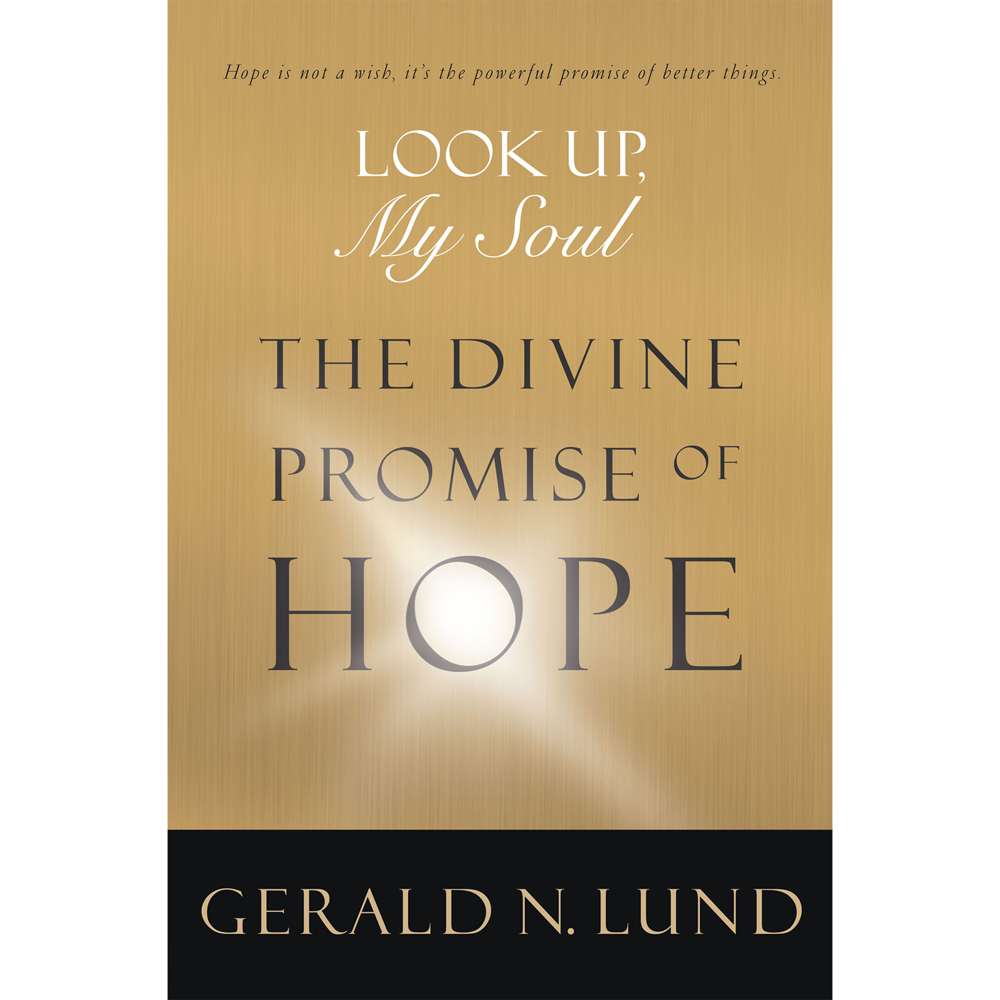
Look Up, My Soul: The Divine Promise of Hope (Hardcover)

(edit)

by Gerald N. Lund

31% OFF

$25.99

List Price

$17.99

Sale Price

+ Earn 180Buy_platinum Points

Buy_readytoship

✔ IN STOCK: Ships in 2 to 3 business days
Domestic and International Shipping Options

Other Formats Available

MP3 Download | Book on CD | Bookshelf eBook

Share
Facebook Icon_twitter Icon_pin Icon_email

Product Description

Faith, Hope, and Charity are known as the three great Christian virtues. And while we may feel as though we know how to exercise faith or extend charity, too many of us are overlooking hope — even though it is exactly what we are seeking.

Hope is more than an attitude of good cheer or a generalized faith in God. President Dieter F. Uchtdorf defined hope as “the abiding trust that the Lord will fulfill His promises to us.” In Look Up, My Soul, Elder Gerald N. Lund leads us through a discussion of the doctrine of hope in such depth and detail, and with such love, that we may be surprised at this unexpected and under-appreciated power that is available to us.

Elder Lund talks about the realities of life in our day, the reasons many of us lack hope, and the need for hope in our time. He shares his insights on such questions as:

  • What is hope?
  • How does hope relate to faith and charity?
  • How do we gain, strengthen, and maintain our hope, especially in times of despair?
  • What role does the Savior play in our efforts to develop hope?
  • What are the divine promises that foster hope?
  • Included in the book are inspirational and enlightening stories — from Church history, the scriptures, Elder Lund's own life, and the lives of others who were willing to share their stories of hope — that invite us to look up and to find joy in the promises the Lord has made to us.

    Hope is more than just a wish that things will get better; it is a power that makes things better. It is a spiritual gift from God, and with His help, we can make hope a vital and vibrant part of our everyday life and of our eternal spiritual survival.

    Deseret News book article about Look Up, My Soul by Trent Toone (Click Here)

    Product Details

    • Size: 6 x 9
    • Pages: 378
    • Published: 03/2012
    • Book on CD: Unabridged
    • Number of Discs: 9
    • Run Time: Approx. 11 hrs.

    About the Author

    Elder Gerald N. Lund received his B.A. and M.S. degrees in sociology from Brigham Young University. He also did extensive graduate work in New Testament studies at Pepperdine University in Los Angeles, California, and studies Hebrew at the University of Judaism in Hollywood, California.


    During his thirty-five years in the Church Educational System, the author served as a seminary teacher, an institute teacher and director, a curriculum writer, director of college curriculum, and zone administrator. His Church callings have included serving as stake president, bishop, and teacher. Elder Lund served as a member of the Second Quorum of the Seventy from 2002 to 2008.


    Elder Lund is a prolific author; his novels include the Work and the Glory series, the Kingdom and the Crown trilogy, Fire of the Covenant, and The Undaunted. He has also written several books on gospel topics, including Hearing the Voice of the Lord and Divine Signatures.


    He and his wife, Lynn, are the parents of seven children. For more information, please visit Gerald Lund’s website (Click Here)

    Preface

    “It Is Better to Look Up”

    In the October 2011 general conference, Elder Carl B. Cook, of the Seventy, told of an experience he had during his first week as a General Authority. It had been a particularly tiring week, and his briefcase was overloaded and his mind preoccupied with this question: “How can I possibly do this?” As he stepped onto the elevator, his head was down and he stared at the floor.

    The elevator stopped on another floor and someone else got on. Elder Cook didn’t look up to see who it was. As the door closed, the person asked, “What are you looking at down there?”

    Elder Cook instantly recognized President Thomas S. Monson’s voice. He looked up and responded, “Oh, nothing.”

    President Monson smiled, pointed heavenward and lovingly suggested, “It is better to look up!” As the elevator continued downward, President Monson explained that he was on his way to the temple.

    They both got off the elevator and parted ways. Elder Cook said this, “When he bid me farewell, his parting glance spoke again to my heart, ‘Now, remember, it is better to look up.’”1

    Surprised by Hope

    People often ask me if I’m working on a new book. If I say yes, they invariably ask me what it is about. When I told them I was working on a book on hope, I typically got one of three reactions:

    • A generic “Oh,” which I interpreted to mean, “Nice, but not too exciting.”

    • A surprised “Really?” followed by, “That’s good. There isn’t much written on hope out there.”

    • A fervent “When will it be out? It’s a really hard time for me (or my son, my daughter, a neighbor, my best friend, etc.) right now. I really need something like that.”

    The genesis of this book was a class I taught in our ward. I was sensing that there seemed to be a lot of people out there struggling with life. They were pressed down by it and trying to cope with chronic discouragement. So I decided to devote a class to the topic of hope. I was a little taken aback by the response. An unusual number of people came up afterward to express how much they needed that topic right now and how relevant it was to what they (or people close to them) were going through. I decided to look into it further to see if there was enough to sustain a book.

    Many years ago, C. S. Lewis, the famous Christian writer from England, wrote a book called Surprised by Joy, which included the story of his conversion to Christianity. I must admit, as I started to explore the topic, I was “surprised by hope.” One thing became immediately evident. It seemed as though I wasn’t the only one sensing this pervasive gloom and dejection. In addition, the Brethren were speaking frequently on the subject in conference. So much for there not being much material out there.

    Another thing that surprised me was just how central hope is to the gospel of Jesus Christ. How had I missed that all these years? I knew it was one of the “big three” Christian attributes—faith, hope, and charity—but I had always secretly wondered why hope took precedence over other things like repentance or personal revelation. I don’t wonder about that anymore. Instead, I am filled with a sense of wonder—along with some embarrassment that it took me so long to get here—at what I have come to understand about hope. It has expanded my understanding of the entire gospel plan and deepened my appreciation for the love and wisdom of our Heavenly Father.

    I would like to express my sincere appreciation to those whose stories are included either in a chapter or in an additional section between chapters. Good teaching always involves two major objectives: We teach for understanding and we teach for application. The chapters in the book try to teach the principles and doctrines related to hope. Without that understanding, we cannot fully appreciate hope. But the stories and examples used herein are meant to illustrate how those principles are actually applied in our lives. They make the doctrine of hope more tangible and alive.

    Many of those who shared their stories chose to remain anonymous, but that does not lessen the value of their contributions. I thank them for their willingness to share what, in many cases, are painful and tender things.

    One small housekeeping matter: I often emphasize key words or phrases in scriptural passages or quotations with italics. Rather than tediously indicating each time that the emphasis is mine, I have only specified when the emphasis was in the original.

    This has been a difficult book for me to write, and my first attempts fell far short of where I wanted the book to be. I wish to express my thanks to those who read the manuscript early on and gave me input. Their honesty, forthrightness (always served up with a generous dose of tactful kindness), and considerable wisdom and insights have had an enormous impact on the end product. My deepest thanks to each of you.

    As usual, I owe much to the consistent support, encouragement, and solid efforts of the Deseret Book staff. It takes a tremendous amount of diligence and care to edit, design, publish, and market a book such as this. Once again, they have done so with their usual commitment to excellence.

    Though I never saw this coming, as it turns out, this book completes what could be considered a somewhat loosely linked gospel trilogy. Hearing the Voice of the Lord (2007) focused on personal revelation. Divine Signatures (2010) showed how personal revelation—especially those events we called “divine signatures”—can expand our understanding of God’s nature and deepen our faith and trust in Him. Look Up, My Soul (2012) takes that concept one step further.

    In this book, hope is defined as not just trust in God, but trust in His promises. We learn of those promises through revelation, and it is through revelation that the promises are confirmed. Thus, the three books stand together as a witness of the reality, majesty, perfections, power, and glory of our Heavenly Father and His Beloved Son.

    To Them, I owe the greatest debt of all.

    “Look Up, My Soul”

    Early in my life, I learned to love the hymns we sing. As I moved into adulthood, I came to realize that they are like the scriptures in some ways. The lyrics are filled with eternal truths, contain concepts that inspire, and have the power to heal the wounded soul (see Jacob 2:8). I can remember one of those moments many years ago when I was weighed down by a particular difficulty. Then in sacrament meeting, we sang a hymn that I wasn’t familiar with: “Before Thee, Lord, I Bow My Head.” I immediately fell in love with the words, but it was the third verse that hit me with particular force.

    Look up, my soul; be not cast down.

    Keep not thine eyes upon the ground.

    Break off the shackles of the earth.

    Receive, my soul, the spirit’s birth.2

    That is my hope for this book. May it help us all to remember President Monson’s counsel, “It is better to look up.”

    Notes

    ^1. Carl B. Cook, “It Is Better to Look Up,” Ensign, November 2011, 33.

    ^2. “Before Thee, Lord, I Bow My Head,” in Hymns of The Church of Jesus Christ of Latter-day Saints (Salt Lake City: The Church of Jesus Christ of Latter-day Saints, 1985), no. 158.

    Preface

    “It Is Better to Look Up” In the October 2011 general conference, Elder Carl B. Cook, of the Seventy, told of...

    Horz_line

    Chapter One

    “Look Up, My Soul” Humble yourselves in the sight of the Lord, and he shall lift you...

    Horz_line

    Rating_star Rating_star Rating_star Rating_star Rating_star


    Worth a reread!

    by Sherrie - reviewed on January 29, 2013

    A great resource. Gerald Lund teaches with clarity and provides numerous quotes and personal experiences to help us identify the need and role of hope in our lives.

    Rating_star Rating_star Rating_star Rating_star Rating_star


    Valuable.

    by Customer - reviewed on February 19, 2013

    There is so much strength to be found in this book. I am ordering a second for a young adult in our ward who is facing many challenges.

    Product Downloads


    Title

    Time

    Artist

    Price

    Popularity


    Look Up, My Soul: The Divine Promise of Hope
    Audio Book
     
    Gerald N. Lund (author)  
    $29.99
     
    Buysong
    Join Platinum Rewards Club
    Rewards_club_shield

    Earn points on every purchase, plus get other great benefits.
    Learn more

    Customers Also Bought
    since1866