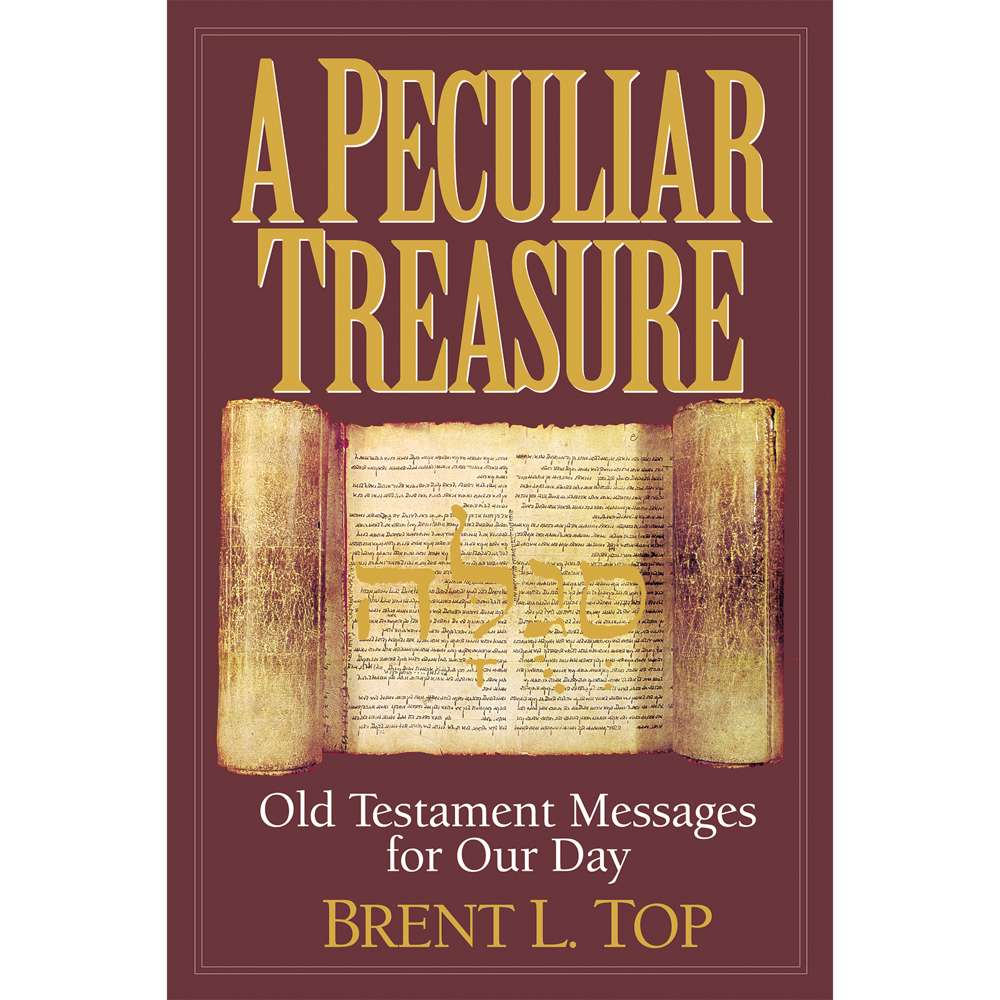
A Peculiar Treasure: Old Testament Messages for Our Day (Paperback)
by Brent L. Top
$18.99
List Price
✔ IN STOCK: Ships in 2 to 3 business days
Domestic and International Shipping Options
Other Formats Available
Product Description
The Old Testament is amazingly relevant to our day and can help you come to know Christ. Thankfully, you don't have to be a biblical scholar to understand its most profound messages.
In his conversational style, author Brent L. Top shows how the Old Testament, rather than being merely a collection of archaic laws and obscure history, is an exciting, faith-affirming record that witnesses of Christ and speaks of contemporary challenges and concerns.
One major Old Testament theme discussed is that the Lord's covenant people are his "peculiar treasure." The Old Testament reveals the Lord's diligent care for his people, and how the appellation "peculiar treasure" may be bestowed upon the Old Testament itself as well.
Among other messages, the author also discusses the timelessness of the Ten Commandments, the imagery of the bride and the bridegroom, and the modern relevancy of the ancient Nazarite vow.
About the Author
Brent L. Top is a professor and the chair of Church history and doctrine at BYU, where he has also served as associate dean of Religious Education. Brother Top has written numerous books, including co-authoring LDS Beliefs: A Doctrinal Reference, and is a popular speaker at BYU Education Week. He served as mission president of the Illinois Peoria Mission and is currently serving as a stake president. Brent and his wife, Wendy, are the parents of four children and live in Pleasant Grove, Utah.
Chapter One
Now therefore, if ye will obey my voice indeed, and keep my covenant, then ye shall be a peculiar treasure unto me above all people: for all the earth is mine: and ye shall be unto me a kingdom of priests, and an holy nation.
—Exodus 19:5–6
CHAPTER ONE
A Covenant People: God’s Peculiar Treasure
When I was a senior in high school I received a remarkable Christmas present from my parents. While it may not seem so remarkable to anyone else, it was one of the best gifts I have ever received. I was playing on the varsity basketball team, and I ate, drank, dreamed, and lived basketball at that time in my life. My mother found a porcelain figurine in a gift shop and then had someone sand off the colors and repaint it in our school colors—complete with my jersey number, my name on the back, and our high school insignia on the ball the player was holding. (I have to admit that the artist made the figure much more handsome than me.) Mom then had it gift-wrapped in my high school colors. I don’t know how much it cost, but no amount of money could have made this present more valuable to me.
As the years passed this simple Christmas gift became even more special—not because I had had a great basketball career, but because it represented my parents’ deep love for me. I have received many Christmas gifts through the years, most of which I can’t even remember. The majority I used for a short time and then discarded. Perhaps today some of those gifts that I once thought were so important lie rusting and eroding in some landfill. But this special gift is different. I put this little figurine in a prominent place—first in my room and then later, after I was married, in our home, and finally, when I became a teacher, in my office. People coming into my office would often comment on how unique it was. Truly it was unique because no one else in the world had a figurine just like mine, and certainly it was unique because it came from my parents, especially for me. It was a priceless possession, an irreplaceable heirloom.
I have thought often of this precious gift and my parents’ love for me when I read in the Old Testament of ancient Israel being characterized as a “peculiar” people. In our modern English vernacular the word peculiar is interpreted to mean “different,” “strange,” or even “weird.” But that is not the intended meaning in the Old Testament.
After Jehovah had miraculously liberated the Israelites from their bondage in Egypt, he led them in a marvelous manner so that they would know that he was indeed with them—in a cloud by day and a pillar of fire at night (see Exodus 13:20–22; Numbers 14:14). At the base of Mount Sinai Moses commanded the Israelites, as instructed by the Lord Jehovah, to prepare themselves to be in the Lord’s holy presence. Because of his great love for them, God was renewing his covenant with them if they would keep their covenants with him.
And Moses went up unto God, and the Lord called unto him out of the mountain, saying, Thus shalt thou say to the house of Jacob, and tell the children of Israel;
Ye have seen what I did unto the Egyptians, and how I bare you on eagles’ wings, and brought you unto myself.
Now therefore, if ye will obey my voice indeed, and keep my covenant, then ye shall be a peculiar treasure unto me above all people: for all the earth is mine:
And ye shall be unto me a kingdom of priests, and an holy nation. (Exodus 19:3–6; emphasis added.)
The Hebrew word for peculiar is segullah, which signifies a property or treasure that is exceedingly precious and is diligently cared for and painstakingly preserved. In a modern context, God is offering to make us his prized possession that he will lovingly look after and protect if we will keep his covenant. Segullah means that Israel, both ancient and modern, can become a treasure endeared unto the Lord, unlike anything else in the world, if we will keep the covenant. What is the covenant that, if kept, transforms ordinary men and women into segullah or “a peculiar treasure” and a “holy nation”?
THE ABRAHAMIC COVENANT
A gospel covenant is an agreement between God and man. Man promises obedience to the Lord’s will and dedicates his life to the Lord’s service; in turn, God promises glorious blessings, even unto “all that [the] Father hath” (D&C 84:38; see also vv. 34–39). The Old Testament repeatedly refers to the “covenants of the fathers,” and we generally think of the covenants and blessings associated with Abraham, Isaac, and Jacob, but the covenant predates even these ancient patriarchs. The Lord made great promises to Enoch and Noah based on their faithfulness (see Genesis 6:18, 22; JST, Genesis 13:14). Undoubtedly Adam and his seed made similar covenants (see Moses 6:53–68). These covenants and blessings are merely mortal extensions of the “everlasting covenant” that was also extant in the premortal realm. Just as ancient Israel became the chosen people through their faithfulness to the covenants of their fathers, those who kept the everlasting covenant of the gospel in their premortal existence became segullah, God’s peculiar treasure on earth. “There was a group of souls tested, tried, and proven before they were born into the world, and the Lord provided a lineage for them,” Elder Marvin J. Ballard taught. “That lineage is the house of Israel, the lineage of Abraham, Isaac and Jacob and their posterity. Through this lineage were to come the true and tried souls that had demonstrated their righteousness in the spirit world before they came here.” (Melvin J. Ballard—Crusader for Righteousness[Salt Lake City: Bookcraft, 1966], pp. 218–19.)
On earth the prototype of covenant-keeping was Father Abraham. In the Old Testament he is the focal point of the covenant; all subsequent references to it and to the blessings for obedience and curses for disobedience grow out of Father Abraham’s righteous example. He was faithful in keeping his covenant to do all that God commanded, even being willing to offer his only son as a required sacrifice (see Genesis 22:1–18; Hebrews 11:17–19). Because of his faith and righteousness, the Lord promised to provide certain blessings and opportunities for him and all his lineal and adopted descendants who would likewise faithfully adhere to the everlasting covenant. Four great blessings were promised to the covenantal seed of Abraham:
1. A promised land. “Lift up now thine eyes, and look from the place where thou art northward, and southward, and eastward, and westward: for all the land which thou seest, to thee will I give it, and to thy seed for ever” (Genesis 13:14–15).
2. A great posterity. “I will bless thee, and in multiplying I will multiply thy seed as the stars of the heaven, and as the sand which is upon the sea shore; and thy seed shall possess the gate of his enemies” (Genesis 22:17).
3. The everlasting priesthood and the blessings of the gospel. “I will establish my covenant between men and thee and thy seed after thee in their generations for an everlasting covenant, to be a God unto thee, and to thy seed after thee” (Genesis 17:7).
4. A responsibility to share the gospel of salvation. “And I will make of thee a great nation, and I will bless thee above measure, and make thy name great among all nations, and thou shalt be a blessing unto thy seed after thee, that in their hands they shall bear this ministry and Priesthood unto all nations;… and in thy seed after thee… shall all the families of the earth be blessed, even with the blessings of the Gospel, which are the blessings of salvation, even of life eternal” (Abraham 2:9, 11).
These aspects of the Abrahamic covenant have both a temporal and a spiritual application. While much of the Old Testament deals with the literal fulfillment and eventual loss of the blessings of seed, land, and priesthood, there is a much greater spiritual meaning of the covenant. In their fullest sense, these promises are realized only through the blessings of the fulness of the gospel. Inheriting the “promised land” eternally is realized by inheriting the millennial lands of promise (see 2 Nephi 6:11; 10:7–8) and ultimately by inheriting the celestialized earth (see D&C 130:9).
Millions on earth can claim Father Abraham as their great progenitor, yet the only way that those who inherit the blessings of Abraham, Isaac, and Jacob can have seed as numerous as the stars is through the covenant of celestial marriage. As the Lord declared unto the Prophet Joseph Smith:
Abraham received promises concerning his seed, and of the fruit of his loins—from whose loins ye are, namely, my servant Joseph—which were to continue so long as they were in the world; and as touching Abraham and his seed, out of the world they should continue; both in the world and out of the world should they continue as innumerable as the stars; or, if ye were to count the sand upon the seashore ye could not number them.
This promise is yours also, because ye are of Abraham, and the promise was made unto Abraham; and by this law is the continuation of the works of my Father, wherein he glorifieth himself.
Go ye, therefore, and do the works of Abraham; enter ye into my law and ye shall be saved.
But if ye enter not into my law ye cannot receive the promise of my Father, which he made unto Abraham. (D&C 132:30–33.)
This is the covenant that God has made with his people—the everlasting covenant which, if obeyed, results in his people being segullah, or a peculiar treasure that is blessed of the Lord and which blesses the world (see Abraham 2:9–11; see also Kent P. Jackson, “The Abrahamic Cove nant: A Blessing for All People,” Ensign, February 1990, pp. 50–53).
“YE ARE BOUGHT WITH A PRICE”
One of the interesting connotations of the Hebrew word segullah is that of a special possession or treasure that has been purchased. The idea is even more evident in the Greek word peripoiesis, from which the word peculiar is translated in the New Testament. This Old Testament theme takes on added significance when the Apostle Peter teaches in the New Testament that through the blood of Christ “ye are a chosen generation, a royal priesthood, an holy nation, a peculiar people; that ye should shew forth the praises of him [Christ] who hath called you out of darkness into his marvellous light” (1 Peter 2:9; emphasis added). Becoming a peculiar people, or a precious treasure unto God, comes through the everlasting covenant and the Atonement of Jesus Christ. “For ye are bought with a price,” the Apostle Paul declared (1 Corinthians 6:20).
All of the commandments associated with the covenants of the fathers described in the Old Testament are designed to lead people to the salvation that is to be found only in Christ and his everlasting gospel. The great blessings of being segullah are not found merely in possessing promised lands or having numerous seed, but in being safeguarded in the protection of God’s loving covenant. “I will save them out of all their dwellingplaces, wherein they have sinned, and will cleanse them: so shall they be my people, and I will be their God,” Jehovah declared to covenant Israel. “Moreover I will make a covenant of peace with them; it shall be an everlasting covenant with them: and I will place them, and multiply them, and will set my sanctuary in the midst of them for evermore.
My tabernacle also shall be with them: yea, I will be their God, and they shall be my people.
And the heathen shall know that I the Lord so sanctify Israel, when my sanctuary shall be in the midst of them for evermore.” (Ezekiel 37:23, 26–28.)
BEING DIFFERENT FROM THE WORLD
Unlike my basketball figurine, a “peculiar treasure” is not for display purposes only. God doesn’t have a chosen people to keep in a trophy case. The blessings of the covenant are inseparably linked to its responsibilities. Being segullah requires being peculiar—not weird or strange, but unique, different from those who reject God’s covenant. For this reason the Lord instructed Moses to teach the Israelites not to wear their hair or clothes in the same style and manner as their pagan neighbors or to engage in many of the same practices and traditions of those not of the covenant (see Leviticus 19:26–32). “Ye are the children of the Lord your God: ye shall not cut yourselves, nor make any baldness between your eyes for the dead,” the Lord declared. This was not just a matter of taste or style. In order for Israel to perform its sacred responsibilities as part of the Abrahamic covenant—to bless all nations of the earth—they must maintain higher standards. “For thou art an holy people unto the Lord thy God, and the Lord hath chosen thee to be a peculiar people unto himself, above all the nations that are upon the earth” (Deuteronomy 14:1–2). Ancient Israel was often reminded that they could not remain segullah and be like everyone else. Such practice turns an object that is unique and special, or peculiar, into one that is common and cheap.
One of the ways that ancient Israel was reminded of their covenantal role as segullah was through an interesting element associated with the many sacrificial rites of the law of Moses and the carnal commandments. The Lord had instructed that on every sacrifice, regardless of its type, the officiating priest would sprinkle salt. From time immemorial salt has been a preservative and as such has served as an important symbolic reminder to the Israelites. The salt represented the preservation of the covenant throughout the world. It was this familiar symbol that the Savior spoke of when he said to his disciples: “Ye are the salt of the earth: but if the salt have lost his savour, wherewith shall it be salted? it is thenceforth good for nothing, but to be cast out, and to be trodden under foot of men.” (Matthew 5:13.) Just as salt loses its savor only through contamination by impure, foreign elements, the covenant people lose their segullah status and power to “bless the nations of the earth” by becoming impure and unworthy and by abandoning the protective covenants of the Lord.
One of the best Old Testament examples of the results of such contamination is the account of ancient Israel’s desire to have a king. Such a desire was not based on public policy or governmental efficiency but rather on the Israelites’ expressed desire “that we also may be like all the nations” (1 Samuel 8:20). Despite the prophet Samuel’s explicit warnings to them of all of the terrible consequences that would come upon them, they no longer desired to be different, or segullah, but instead wanted to be like others. Samuel took this rejection of their covenantal status personally and felt rejected by his own people, to which the Lord declared, “They have not rejected thee, but they have rejected me, that I should not reign over them” (1 Samuel 8:7). The Old Testament is replete with accounts of hardships, droughts, plagues, and destruction that befell the Israelites because they had rejected the covenant and were no longer worthy to be blessed and protected by the Lord. Such a theme is a relevant warning for us today.
Elder Neal A. Maxwell has spoken of the need to “be different in order to make a difference in the world” (“Why Not Now?” Ensign, November 1974, p. 13). To make such a difference in the world, then, we need to be different from the world. In order for us as modern covenant Israel to fulfill our obligation to the world as the “salt of the earth,” we must remain segullah, a unique, untainted treasure that has been blessed and sanctified by the Lord so that we, in turn, can bless and sanctify the world. To the Prophet Joseph Smith the Lord declared:
When men are called unto mine everlasting gospel, and covenant with an everlasting covenant, they are accounted as the salt of the earth and the savor of men;
They are called to be the savor of men; therefore, if that salt of the earth lose its savor, behold, it is thenceforth good for nothing only to be cast out and trodden under the feet of men. (D&C 101:39–40.)
But inasmuch as they keep not my commandments, and hearken not to observe all my words, the kingdoms of the world shall prevail against them.
For they were set to be a light unto the world, and to be the saviors of men;
And inasmuch as they are not the saviors of men, they are as salt that has lost its savor, and is thenceforth good for nothing but to be cast out and trodden under foot of men. (D&C 103:8–10.)
Just as Moses and other prophets reminded ancient Israel that, because they were segullah, they must not become contaminated by the evil practices of the world around them, modern prophets continually remind us that we too must remain peculiar to receive the blessings of the Lord and to achieve our covenantal destiny. President Gordon B. Hinckley admonished:
Peter speaks of “an holy nation.” He does not refer to a political entity. He refers to a vast congregation of the Saints of God, men and women who walk in holiness before him and who look to Jesus Christ as their Savior and their King…. What a treasured privilege to have citizenship in this holy nation. Never belittle the rights, privileges, and responsibilities that flow therefrom.
Peter’s final description—“a peculiar people.”
Of course you are peculiar. If the world continues its present trend, and if you walk in obedience to the doctrine and principles of this Church, you may become even more peculiar in the eyes of others.
To each of you I say this: As members of The Church of Jesus Christ of Latter-day Saints, you have been taught many values of divine origin. These values are based on the commandments which the finger of the Lord wrote upon the tablets of stone when Moses spoke with Jehovah upon the mountain. You know them. You are familiar with them.
The values you have been taught likewise are based upon the beatitudes which Jesus spoke to the multitude. These, with others of His divine teachings, constitute a code of ethics, a code of values, a code of divine doctrine familiar to you and binding upon you.
To these have been added the precepts and commandments of modern revelation.
Combined together these basic, divinely given principles, laws, and commandments must constitute your value system. You cannot escape the consequences of their observance. If you will shape your lives according to their pattern, I do not hesitate to promise that you will know much of peace and happiness, of growth and achievement. To the degree that you fail to observe them, I regretfully say that the fruits will be disappointment, sadness, misery, and even tragedy.
You of this generation, this chosen generation, this royal priest-hood, this holy nation, you of this peculiar people—you cannot with impunity follow practices out of harmony with values you have been taught. I challenge you to rise above the sordid elements of the world about you. (In Conference Report, April 1992, p. 99.)
A COVENANT OF LOVE
Just as the basketball figurine was a priceless gift of love from my parents to me, so too is God’s covenant with us a matchless gift of infinite love. God does not bestow the designation segullah randomly, like drawing names from a hat, but out of love for his children. Because of that love, the covenant is designed to protect his children from those things of the world that will destroy happiness and bring misery and heartache in their wake. The greatest manifestation of that love is found in Christ and his infinite sacrifice (see John 3:16). The stipulations of his covenant, therefore, are not burdensome or capricious but instead are loving, protective, and merciful. It is this call to be his chosen people that underlies all the Lord’s teachings and dealings with his people that we read in the Old Testament. Though the circumstances and culture are different today, the covenant remains the same and the spiritual quest to become and to remain God’s peculiar treasure is as vital for us today as it was for those in the days of Adam, Abraham, Moses, or Malachi.
For thou art an holy people unto the Lord thy God: the Lord thy God hath chosen thee to be a special people unto himself, above all people that are upon the face of the earth.
The Lord did not set his love upon you, nor choose you, because ye were more in number than any people; for ye were the fewest of all people:
But because the Lord loved you, and because he would keep the oath which he had sworn unto your fathers, hath the Lord brought you out with a mighty hand, and redeemed you out of the house of bondmen, from the hand of Pharaoh king of Egypt.
Know therefore that the Lord thy God, he is God, the faithful God, which keepeth covenant and mercy with them that love him and keep his commandments to a thousand generations….
Thou shalt therefore keep the commandments, and the statutes, and the judgments, which I command thee this day, to do them.
Wherefore it shall come to pass, if ye hearken to these judgments, and keep, and do them, that the Lord thy God shall keep unto thee the covenant and the mercy which he sware unto thy fathers:
And he will love thee, and bless thee, and multiply thee: he will also bless the fruit of thy womb, and the fruit of thy land, thy corn, and thy wine, and thine oil, the increase of thy kine, and the flocks of thy sheep, in the land which he sware unto thy fathers to give thee.
Thou shalt be blessed above all people. (Deuteronomy 7:6–9, 11–14.)
Several weeks after I had taught this important concept in connection with the book of Deuteronomy to my class of Old Testament students at Brigham Young University, a young woman shared with me a letter she had written her parents. The message of the book of Deuteronomy as God’s covenant of love had had such a profound impact on her that she felt compelled to express her feelings to her parents. That kind of spiritual impact, as evidenced in her letter, illustrates how the Old Testament can truly demonstrate “relevancy within antiquity.”
Dear Mom and Dad:
What a day!!! I just had a wonderful experience in my Old Testament class. I knew that if I tried to call and tell you about it that I’d just be one big blubberpuss.
We just studied Deuteronomy—a covenant of love. Moses is sort of giving his farewell address to the Israelites. As I thought to myself what I would say to these stupid, murmuring, slow-to-remember, quick-to-sin people, Deuteronomy became more like a message of fear rather than a covenant of love. I thought, If I were Moses I wouldn’t waste my time reminding them of all that the Lord had done for them—the manna, the quail, the pillar of fire that lit their way, their indestructible clothes, etc. No, I’d remind them of my rage at Sinai, drinking the melted golden calf, the earth swallowing up the rebels, all the plagues, etc. I’d scare them into obedience. Well, I thought that would be a good idea. So, why didn’t Moses do it? Maybe it had something to do with Moses’ connections; maybe he knew something I didn’t. Seriously, why did Moses use his last words to remind Israel of the incredible love God had for them? Brother Top, in our class discussion, helped me answer my own questions.
First of all, fear is not a lasting motivation. We read in the scriptures that we’re supposed to “fear” God. Well, I was right on top of that one. “‘Fear’ means to respect,” I thought to myself. Right? Well, sort of. It actually means to revere. It means adoration. It means love—and love inevitably leads to obedience, service, and righteousness. In fact, it is only through love that these actions are not burdensome. Brother Top gave an example in class of this concept of a husband who cleans the house and makes dinner for his wife who has spent the whole day teaching their three daughters how to ski. His point was that the husband doesn’t do the work begrudgingly. In fact, he was glad to do it, because he loved her so much. You see, it’s imperative that the covenant between God and Israel that is being renewed in Deuteronomy be based on God’s perfect love for his children. If we knew how much Heavenly Father really loves us, we would give up all our sins and be totally righteous. Now this is the part where I started to bawl.
I don’t think I’ve voiced this concern at any time in my life, but I’ve always had this nagging little question as to why I’ve always been such a goody-goody. I don’t mean to say that I’ve lived a sin-free life, but the fact is I have passed up a lot of tempting opportunities to mess up. Why have I been such a good girl? I remember, even as a little kid, passing up some mischievous little crime with my friends and hearing them honestly say, “No way, I can’t do that; my parents would kill me.”… But I was never afraid of you. Then today in our Old Testament class, the answer came to me. It just overwhelmed me. If ever I have made a truly righteous decision, it has been only because I have wanted to. And I’ve only wanted to because I love you so much because you loved me first. It’s not that I feel obligated to be righteous, I want to honor you. Even away from you I never wanted to do anything that would dishonor you. Every aspect of my testimony stems from your love for me. Families are so important.
Mom and Dad, how can I ever thank you enough? I love you so much. Today as we talked about the love Heavenly Father had for the Israelites, I feel like I caught a glimpse for the first time of how much he loves me, because it’s like the love you have for me. That love helps me want to do good and be righteous. What an important lesson from Deuteronomy. Look what the Old Testament has done to me—I’m a wailing wreck now. Man, who would have thought those Israelites could play such a big part in teaching me one of the most important lessons of my life?

Points
Add to My Wish List