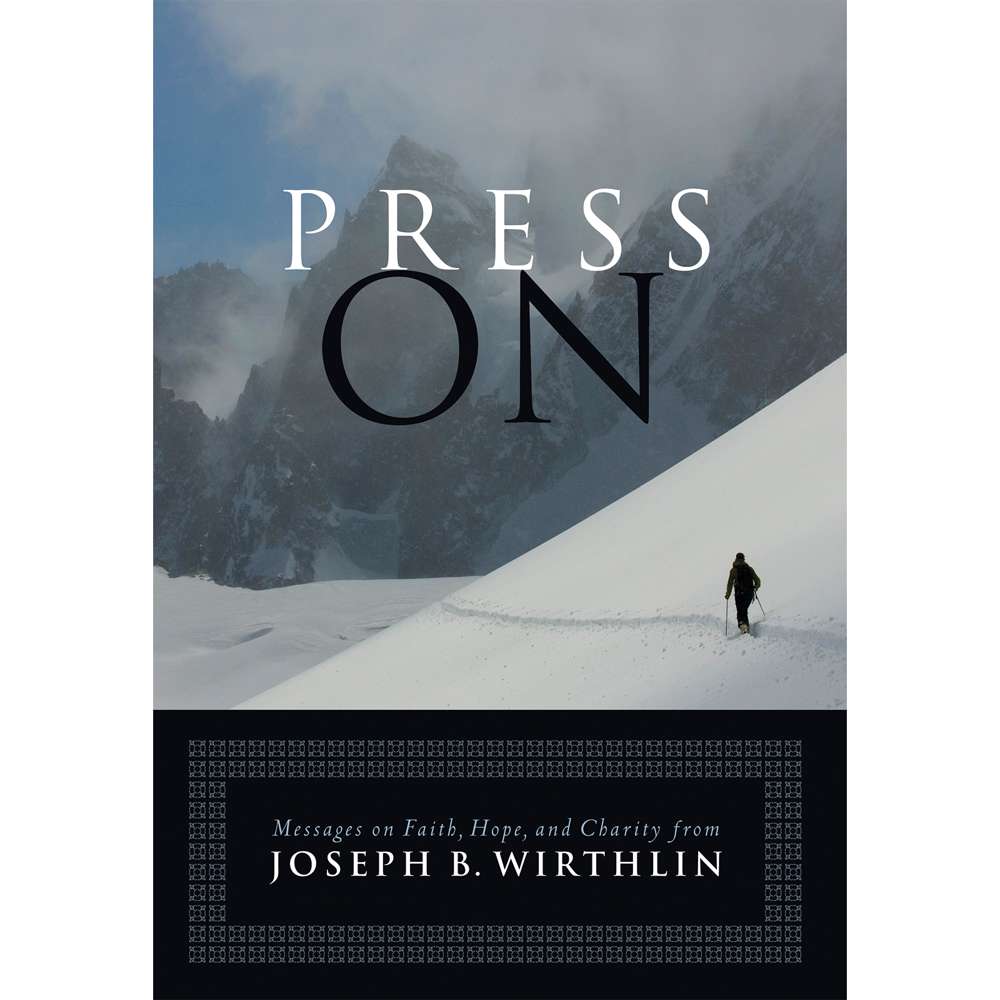
Press On (Bookshelf eBook)
by Joseph B. Wirthlin
eBooks: Looking for more eBooks?
Click here to shop our huge selection of eBooks.
Product Description
Elder Joseph B. Wirthlin is known among his colleagues as a wise man, a resilient man, and a man of complete integrity. He is also known for telling wonderful stories. In Press On, he shares lessons and insights he has gleaned during his life. His messages focus on the three virtues spoken of so eloquently by the Apostle Paul — faith, hope, and charity — virtues that fit us for service in the kingdom here and also prepare us to return to our Heavenly Father's presence. He talks of following the Savior's example, of cultivating divine attributes, and of becoming modern pioneers by being “true to the truth.” Readers will find profound counsel on many vital gospel principles, together with memorable stories, from the mind and heart of a leader who has shown — in word and deed — how to press on.
CONTENTS
- Foreword
- “Follow Me”
- Cultivating Divine Attributes
- Christians in Belief and Action
- Faith of Our Fathers
- Living Water to Quench Spiritual Thirst
- The Abundant Life
- The Unspeakable Gift
- Shall He Find Faith on the Earth?
- True to the Truth
- The Book of Mormon: Foundation of Our Faith PART II: PRESS ON WITH HOPE
- Press On
- Finding a Safe Harbor
- “A More Excellent Way”
- One Step after Another
- Diligence
- Carry On
- Windows of Light and Truth
- Growing into the Priesthood
- Improving Our Prayers
- Pure Testimony PART III: PRESS ON WITH CHARITY
- The Virtue of Kindness
- The Time to Prepare
- Inspired Church Welfare
- Band of Brothers
- Live in Thanksgiving Daily
- Doctrinal Principles Relating to the Family
- Earthly Debts, Heavenly Debts
- The Law of the Fast
- Life’s Lessons Learned
- Joseph Smith’s First Vision
- The Temple
- Sunday Will Come Index
Acknowledgments
PART I: PRESS ON WITH FAITH
About the Author
Chapter 2
Important Dates
We often mark significant dates on our calendars, such as holidays and birthdays. Dates that come around every year help us measure progress in our lives. One annual event, New Year’s Day, is a time of reflection and resolution.
Our baptism date, which commemorates our spiritual rebirth, is an annual occasion worthy of special note. We pause to recognize the date of our temple sealing as a special anniversary because that ordinance binds us together forever with our most cherished loved ones. Worthiness interviews, especially temple recommend interviews, give us another opportunity to review our progress in fulfilling the glorious stewardship our Father in Heaven has given each of us. Certainly we must watch over and care for our own souls. On these occasions, we renew covenants, reaffirm commitments, and reestablish eternal goals.
A few significant events occur only once in a lifetime. For example, in the year 2000, we experienced a New Year’s Day when all four numerals in the calendar year changed at the same time. Public opinion polls at the time indicated that this singular calendar change was “looming increasingly large in the public consciousness.” Surveys showed that
people were also anticipating the moment with “a very positive outlook.” Speaking of that singular event, one forecaster said that the millennial calendar change would “be a profound milestone in people’s lives, an opportunity to stop and start anew” (Outlook, NFO Research, Inc., summer 1998).
The Savior’s Mortal Ministry
The birth of the Savior into mortality is an event of immeasurable significance that occurred some 2,000 years ago. In much of the world, calendar years are numbered forward and backward from the time of His birth. He taught the gospel of repentance and organized His Church, atoned for the sins of all mankind, and was crucified. He was resurrected, opening the way for all to overcome death and have our sins forgiven if we repent. His teachings established standards of human behavior that will endure eternally.
The Second Coming of the Savior
Perhaps in an effort to escape the challenges of our times, a few voices proclaim that the second coming of the Savior is imminent. Perhaps, but the Lord could not have been more plain when He said of His triumphal return to the earth, “But of that day and hour knoweth no man, no, not the angels of heaven, but my Father only” (Matthew 24:36). He taught this truth on the Mount of Olives and repeated it in modern revelation through the Prophet Joseph Smith by saying, “the hour and the day no man knoweth, neither the angels in heaven, nor shall they know until he comes” (D&C 49:7).
Yes, the time will come when “Christ will reign personally upon the earth” (Articles of Faith 1:10). Certainly we are closer to that time now than in 1831 when the Lord admonished the elders of the Church to “labor . . . in my vineyard for the last time—for the last time call upon the inhabitants of the earth. . . . For the great Millennium, of which I have spoken by the mouth of my servants, shall come” (D&C 43:28, 30).
Though we do not know the precise time of the second coming of the Savior, we do know that we are living in the latter days and are closer to that great event than when the Savior lived his mortal life in the meridian of time. We should resolve to begin a new era of personal obedience to prepare for His return. Mortality is fleeting. We all have much to accomplish in preparation to meet Him. As Latter-day Saints, “we believe all things, we hope all things. . . . If there is anything virtuous, lovely, or of good report or praiseworthy, we seek after these things” (Articles of Faith 1:13). What do we believe that will motivate us to move forward? What do we hope for? What are the virtuous, lovely, or praiseworthy things we should seek after? I believe we should strive to develop within ourselves the traits of the character of the Savior.
Faith, Hope, and Charity
The words of the Apostle Paul come to mind: “And now abideth faith, hope, charity, these three; but the greatest of these is charity” (1 Corinthians 13:13). These divine attributes should become fixed in our hearts and minds to guide us in all of our actions. Moroni gives us this wise counsel: “Cleave unto charity, which is the greatest of all. . . . Whoso is found possessed of it at the last day, it shall be well with him” (Moroni 7:46–47). Charity can be the outward expression of faith and hope. If sought and obtained, these three foundation elements of celestial character will abide with us in this life and beyond the veil into the next life. Remember that the “same spirit which doth possess your bodies at the time that [you] go out of this life . . . will have power to possess your body in [the] eternal world” (Alma 34:34). We should not wait a single day to intensify our personal efforts to strengthen these
virtuous, lovely, and praiseworthy attributes.
When we keep the Lord’s commandments, faith, hope, and charity abide with us. These virtues “distil upon [our] soul as the dews from heaven” (D&C 121:45), and we prepare ourselves to stand with confidence before our Lord and Savior, Jesus Christ, “without blemish and without spot” (1 Peter 1:19).
As I read and ponder the scriptures, I see that developing faith, hope, and charity within ourselves is a step-by-step process. Faith begets hope, and together they foster charity. We read in the Book of Mormon, “Wherefore, there must be faith; and if there must be faith there must also be hope; and if there must be hope there must also be charity” (Moroni 10:20). These three virtues may be sequential initially, but once obtained, they become interdependent. Each is incomplete without the others; they support and reinforce each other. Mormon explained, “And except ye have charity ye can in nowise be saved in the kingdom of God; neither can ye be saved in the kingdom of God if ye have not faith; neither can ye if ye have no hope” (Moroni 10:21).
These are the virtuous, lovely, praiseworthy characteristics we seek. We all are familiar with Paul’s teaching that “charity never faileth”
(1 Corinthians 13:8). Certainly we need unfailing spiritual strength in our lives. Moroni recorded the revelation “that faith, hope and charity bringeth [us] unto [the Lord]—the fountain of all righteousness” (Ether 12:28).
The Church of Jesus Christ of Latterday Saints, the restored Church of the Lord on the earth today, guides us to the Savior and helps us develop, nurture, and strengthen these divine attributes. In fact, He revealed the qualifications required to labor in His service in these words: “No one can assist in this work except he shall be humble and full of love, having faith, hope, and charity” (D&C 12:8).
Mormon taught that “charity is the pure love of Christ” and exhorted us to “pray unto the Father with all the energy of heart, that [we] may be filled with this love, which he hath bestowed upon all who are true followers of his Son, Jesus Christ” (Moroni 7:47–48). Note that charity is given only to those who seek it, only to those who earnestly pray for it, only to those who are disciples of Christ. Before we can be filled with this pure love, we must start at the beginning with the first principle of the gospel. We must have “first, Faith in the Lord Jesus Christ” (Articles of Faith 1:4).
Faith
“Now faith is the substance of things hoped for, the evidence of things not seen” (Hebrews 11:1; emphasis added). “Faith is not to have a perfect knowledge of things; therefore if [we] have faith [we] hope for things which are not seen, which are true” (Alma 32:21). Latter-day Saints can rejoice in the strength of our faith because we have the fulness of the gospel. If we study, ponder, and pray, our faith in the unseen but true things of God will grow. Even if we start with only “a particle of faith, . . . even if [we] can no more than desire to believe” (Alma 32:27. See also verses 28–43), with nurturing attention, a tiny seed of faith can grow into a vibrant, strong, fruitful tree of testimony.
Faith in the Lord, Jesus Christ, motivates us to repent. Through repentance, made possible by the Lord’s atonement, we can feel the calming peace of forgiveness for our sins, weaknesses, and mistakes. With faith in a spiritual rebirth, we are baptized and receive the gift of the Holy Ghost.
We strive to keep the commandments of God, acting on our faith that obedience will help us become as He is. By virtue of the resurrection of our Savior, we have faith that death is not the end of life. We have faith that we once again will know the pleasant company and warm embrace of loved ones who have departed from mortality.
Hope
Mormon asked the Saints of his day, “And what is it that ye shall hope for?” He gave them this answer: “Behold I say unto you that ye shall have hope through the atonement of Christ and the power of his resurrection, to be raised unto life eternal, and this because of your faith in him according to the promise” (Moroni 7:41). In Ether, we learn that “whoso believeth in God might with surety hope for a better world, yea, even a place at the right hand of God, which hope cometh of faith, [and] maketh an anchor to the souls of men” (Ether 12:4).
Even when the winds of adversity blow, our Father keeps us anchored to our hope. The Lord has promised, “I will not leave you comfortless” (John 14:18), and that He will “consecrate [our] afflictions for [our] gain” (2 Nephi 2:2). Even when our trials seem overwhelming, we can draw strength and hope from the sure promise of the Lord:
“Be not afraid nor dismayed . . . for the battle [is] not yours, but God’s” (2 Chronicles 20:15).
Charity
Once faith grows into a firm, abiding testimony, giving us hope in our Heavenly Father’s plan of happiness; once we see through the eye of faith that we are children of a loving Father who has given us the gift of His Son to redeem us, we experience a mighty change in our hearts (see Alma 5:14). We feel “to sing the song of redeeming love” (Alma 5:26), and our hearts overflow with charity. Knowing that the love of God
“is the most desirable of all things . . . and the most joyous to the soul” (1 Nephi 11:22–23), we want to share our joy with others. We want to serve them and bless them.
Family
“The Family: A Proclamation to the World” clearly states the sacredness of the family and declares that a “husband and wife have a solemn responsibility to love and care for each other and for their children” (Ensign, Nov. 1995, 102). Children should be taught at an early age of the sacredness of temples and that their ultimate goal should be to go to the temple to enjoy the blessings that our Heavenly Father has in store for them. The parents’ fondest hope is that their children will come to know for themselves that receiving the sacred temple ordinances is the greatest blessing that can come to them in this life.
Temples
The ideals of faith, hope, and charity are most evident in the holy temples. There we learn the purpose of life, strengthen our commitment as disciples of Christ by entering into sacred covenants with Him, and seal our families together for eternity across generations. Receiving our own endowment in a temple and returning frequently to perform sacred ordinances for our kindred dead increases our faith, strengthens our hope, and deepens our charity. We receive our own endowment on the basis of faith and hope in the Lord’s merciful plan for His children and in the divine potential within each of us as children of our Heavenly Father. It is that same faith and hope that enables us to remain true to the end in keeping the covenants we make. Performing temple ordinances for the dead is a manifestation of charity, offering essential blessings to those who have preceded us, blessings that were not available to them during their own mortal lives. We have the privilege of doing for them what they are unable to do for themselves.
When President Gordon B. Hinckley announced the construction of an unprecedented number of new temples in April 1998, he declared that “temple ordinances become the crowning blessings the Church has to offer” (“New Temples to Provide ‘Crowning Blessings’ of the Gospel,” Ensign, May 1998, 88). President Hinckley is extending these crowning blessings to more Latter-day Saints than ever before. In the house of the Lord, faithful Church members can be endowed “with power from on high” (D&C 95:8), power that will enable us to resist temptation, honor covenants, obey the Lord’s commandments, and bear fervent, fearless testimony of the gospel to family, friends, and neighbors.
In July 1998, we were privileged to participate with President Hinckley in the dedication of the Monticello Utah Temple, the first of the new generation of temples that the Lord has directed our prophet to have built closer to the Saints. What a great spiritual experience that was to be among faithful Saints who never expected that a temple would be built in their town. These are people of great faith; some of them are descendants of the Hole-in-the-Rock pioneers who struggled, labored, and sacrificed through many years of toil to establish Zion on the high plateaus of southeastern Utah (see Church News, 1 Aug. 1998, 4).
Great things are happening in the Church! We are moving forward as never before. President Hinckley’s leadership is challenging us to rise to the occasion. We will attain new levels of spirituality and place our lives in closer harmony with Jesus the Christ based on how fully faith, hope, and charity become integral components of our lives. We surely will have challenges and trials, but with more assurance than ever we will have greater peace and joy, for He has promised us His peace (see John 14:27).
(Adapted from an October 1998 general conference address)
Inspiring and Timely
by Toni - reviewed on May 04, 2008
Powerful Spirit with this book. Bro. Wirthlin's personal experiences and counsel are touching and encouraging especially for our current times. Wonderful talks compiled with inspirational motivations. Very heartfelt.
Get Insights!
by Customer - reviewed on December 29, 2008
This book is an awesome book to help you have hope and faith! It will help you look at things in a different light
Inspirational
by Customer - reviewed on September 21, 2008
This book really helped me to look forward and keeping going throughout all of my trials

Points
Add to My Wish List